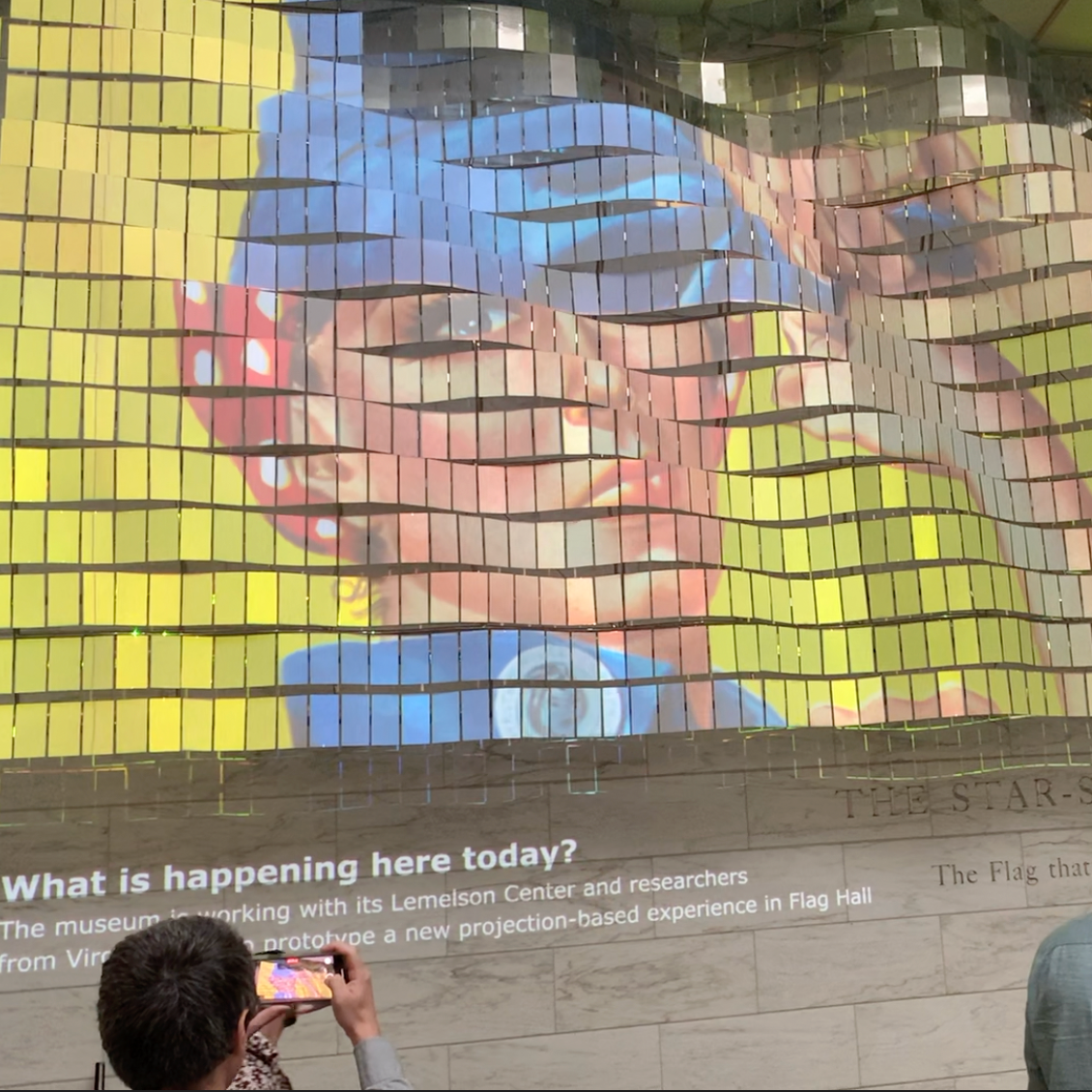
In May 2022, the ICAT team laser scanned Flag Hall to produce a dimensionally accurate digital model, enabling precise virtual projector mockups to determine ideal lensing, brightness, and placement for illuminating the Abstract Flag. An initial in-person test with a 14,000-lumen projector confirmed the need to modify the sculpture’s surface to better receive light. To preserve the original structure, the team tested nine reversible projection films—typically used on glass—by projecting test imagery and taking incident light measurements. Two films were selected for large-scale testing: one light, one dark. To avoid damage from adhesives, the films were applied to laser-cut acrylic panels, creating 150 modular projection units.
These panels were installed in under 30 minutes using a lift, with ambient light levels documented throughout the day. Final projection tests employed a 32,000-lumen, 4K projector—requiring a 240V, 30A circuit—positioned on Flag Hall’s third floor. Historical and museum-originated visuals were projected onto three test zones: the two film-treated areas and an unaltered control section. This project demonstrates a non-invasive method for integrating media art into culturally sensitive environments through a rigorous combination of digital modeling, materials testing, and high-powered projection design.